
Interview with the ODEG
#Eisenbahn #InnoTrans2026 #Ausbildung
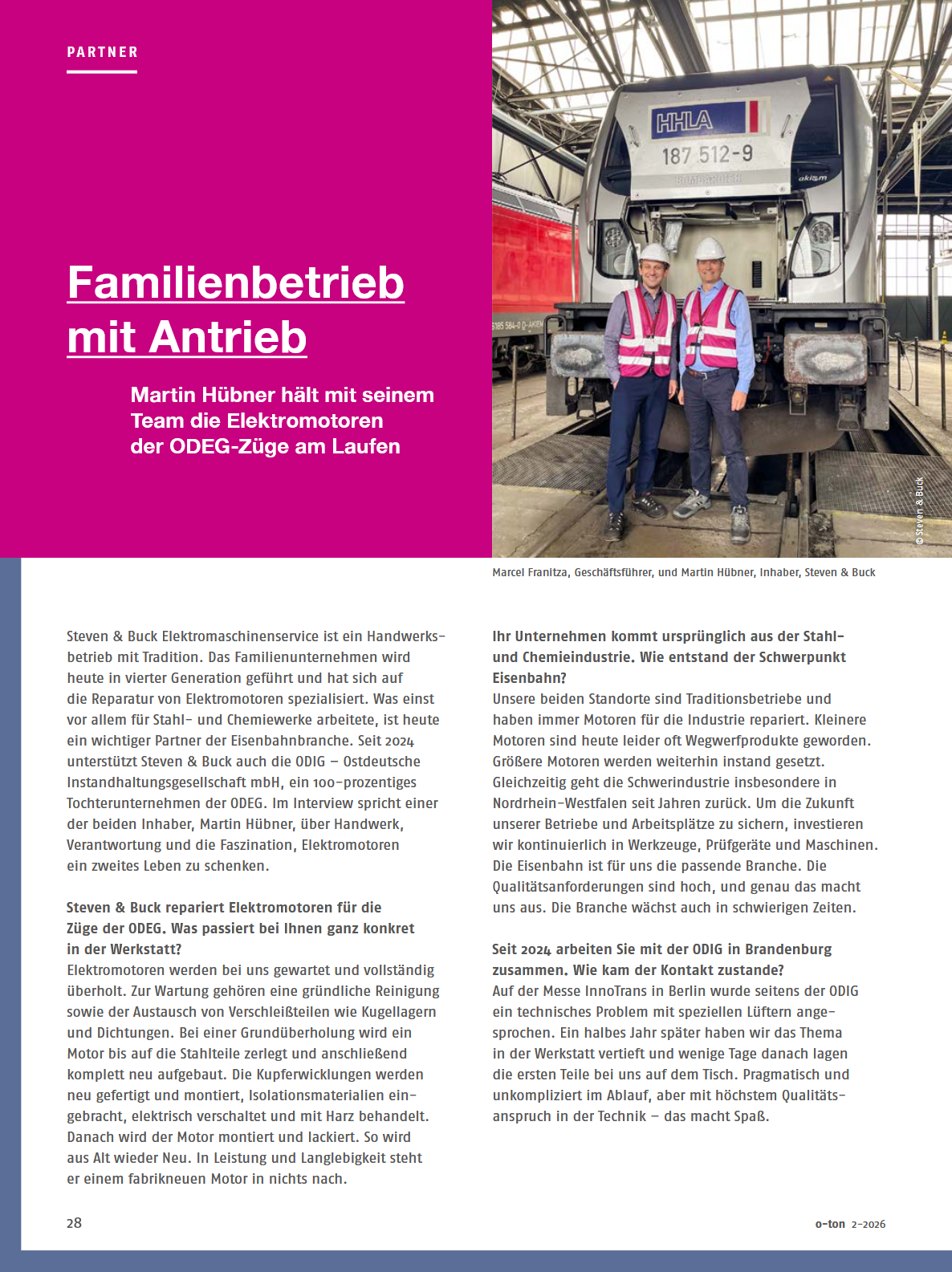
Steven & Buck repairs electric motors for ODEG trains. What exactly happens in your workshop?
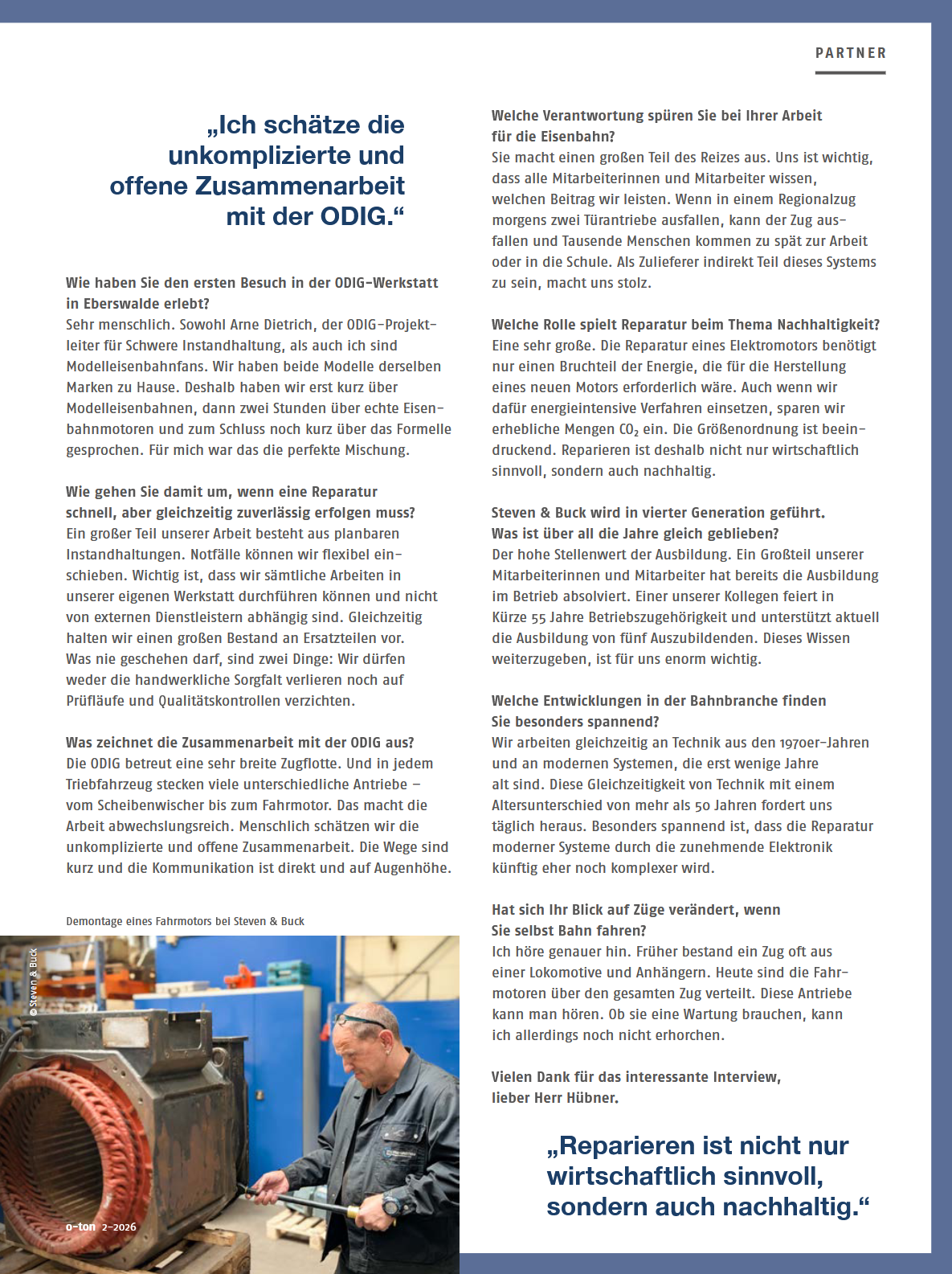
We service and completely overhaul electric motors. Maintenance includes thorough cleaning and the replacement of wear parts such as bearings and seals. During a complete overhaul, a motor is dismantled down to its steel components and then rebuilt from scratch. Copper windings are newly manufactured and installed, insulation materials are applied, electrical connections are made, and the motor is treated with resin. Finally, the motor is reassembled and painted. In this way, old becomes new again. In terms of performance and service life, it is every bit as good as a brand-new motor.
Your company originally comes from the steel and chemical industries. How did you develop a focus on railways?
Both of our sites are traditional businesses and have always repaired motors for industry. Unfortunately, smaller motors have increasingly become disposable products. Larger motors, however, continue to be refurbished. At the same time, heavy industry, particularly in North Rhine-Westphalia, has been declining for years. To secure the future of our businesses and jobs, we continuously invest in tools, testing equipment, and machinery. Railways are the right industry for us. The quality requirements are high, and that is exactly what defines us. The sector continues to grow even in difficult times.
Since 2024, you have been working with ODIG in Brandenburg. How did the collaboration begin?
At InnoTrans in Berlin, ODIG mentioned a technical issue involving special ventilation units. About six months later, we explored the matter further in our workshop, and only a few days later the first components arrived at our facility. The process was pragmatic and straightforward, yet driven by the highest technical quality standards. That is something we really enjoy.
How did you experience your first visit to the ODIG workshop in Eberswalde?
It was a very human experience. Both Arne Dietrich, ODIG's project manager for heavy maintenance, and I are model railway enthusiasts. We both have models from the same brands at home. So first we talked briefly about model railways, then spent two hours discussing real railway motors, and finally a few minutes on the formal aspects. For me, it was the perfect combination.
How do you handle repairs that must be completed quickly while still remaining reliable?
A large part of our work consists of scheduled maintenance. Emergencies can be accommodated flexibly. What is important is that we can carry out all work in our own workshop and are not dependent on external service providers. At the same time, we maintain a large stock of spare parts. There are two things that must never happen: we must never compromise on craftsmanship, nor can we skip testing and quality-control procedures.
What characterizes your collaboration with ODIG?
ODIG maintains a very diverse fleet of trains. Every rail vehicle contains numerous different drives, from windshield wipers to traction motors. This makes the work highly varied. On a personal level, we value the straightforward and open cooperation. Communication channels are short, and discussions are direct and conducted on an equal footing.
What sense of responsibility do you feel in your work for the railway industry?
It is a major part of what makes the work so appealing. It is important to us that every employee understands the contribution we make. If two door drives fail on a regional train in the morning, the train may be cancelled and thousands of people could arrive late for work or school. Being an indirect part of this system as a supplier makes us proud.
What role does repair play in sustainability?
A very significant one. Repairing an electric motor requires only a fraction of the energy needed to manufacture a new one. Even though some of our processes are energy-intensive, we still save substantial amounts of CO₂. The scale of these savings is remarkable. Repairing is therefore not only economically sensible but also sustainable.
Steven & Buck is now managed by the fourth generation. What has remained unchanged over the years?
The importance of vocational training. A large proportion of our employees completed their apprenticeships within the company. One of our colleagues is about to celebrate 55 years of service and is currently helping to train five apprentices. Passing on this knowledge is extremely important to us.
Which developments in the railway sector do you find particularly exciting?
We work simultaneously with technology from the 1970s and with modern systems that are only a few years old. Dealing every day with technology that differs in age by more than 50 years is both challenging and fascinating. What is particularly interesting is that the repair of modern systems is likely to become even more complex due to the increasing use of electronics.
Has your perspective on trains changed when you travel by rail yourself?
I listen more carefully. In the past, a train often consisted of a locomotive and passenger coaches. Today, traction motors are distributed throughout the entire train. You can actually hear these drives. However, I still cannot tell by listening whether they need maintenance.
Thank you very much for this interesting interview, Mr. Hübner.